
Dispatches in Decarbonization: 10 Forces Reshaping Building Decarbonization and How Leaders Can Meet the Moment

This article first appeared in Mahesh Ramanujam’s monthly LinkedIn newsletter, Dispatches in Decarbonization, on February 3, 2026. Subscribe on LinkedIn to receive these updates.

The built environment is at the front and center of climate strategy. Buildings account for roughly one-third of global energy use and emissions, and buildings sit at the intersection of climate risk, regulation, capital markets, and operational performance. The question facing leaders today isn’t whether to decarbonize, but how quickly and credibly can they demonstrate real, verifiable progress.
Building owners, operators, investors and developers consistently ask me the same question: How is the landscape changing and how do we future-proof assets while protecting value? The answer is straightforward:
The landscape has already shifted.
Regulation, climate risk, and capital expectations are converging and the organizations acting now are the ones reducing exposure and strengthening their portfolios. Waiting is no longer a neutral position – it puts owners at risk.
These dynamics are already reshaping decisions across the sector. Below are ten forces reshaping decarbonization in the built environment and how the Global Network for Zero (GNFZ) is enabling organizations to convert pressure into measurable progress.
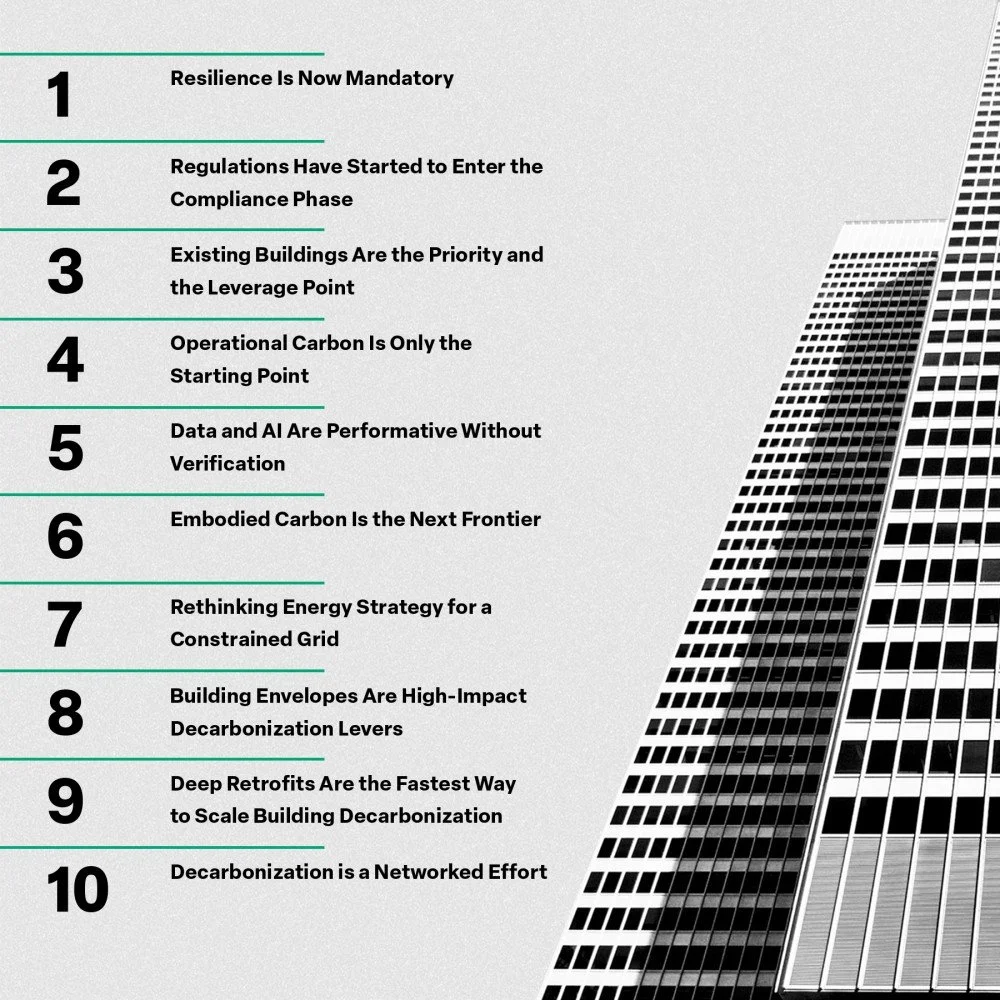
1. Resilience Is Now Mandatory
Net zero strategies that ignore climate risk are already outdated. Extreme heat, flooding, water stress, and grid instability are no longer hypothetical. These risks are disrupting building performance, driving up insurance costs, stranding assets, and destroying long-term value. Strategies that simultaneously reduce emissions and strengthen resilience are becoming core to leading sustainability practices.
Action: Integrate emissions reduction and climate resilience into a single, executable strategy that is focused on future-proofing your assets.
How to Leverage GNFZ: GNFZ certification helps teams quantify emissions across Scopes 1, 2, and 3, and embed resilience measures that protect long-term asset performance.
2. Regulations Have Started to Enter the Compliance Phase
Building performance standards are rolling out across jurisdictions with enforceable deadlines and financial consequences. Building assets that fail to meet these deadlines risk higher operating costs, reputational exposure, and restrictions on building use. Delaying action is no longer a viable financial strategy.
Action: Put in place an achievable decarbonization roadmap that stays ahead of regulations instead of playing regulatory catch up and increasing reputational risk.
How to Leverage GNFZ: GNFZ unifies global standards and local requirements, including NYC’s LL97 emissions factors, in a single platform. While GNFZ uses the GHG Protocol as our underlying accounting framework for our certification, our platform is intentionally flexible and can accommodate jurisdiction-specific carbon coefficients. This helps to ensure that you are working off on one roadmap with proven methodologies, without duplicating work.
3. Existing Buildings Are the Priority and the Leverage Point
New construction matters, but existing buildings are where we can make the most difference in near-term emissions reductions. Remember, we are facing global climate goals that are rapidly approaching at the end of this decade. Retrofitting existing buildings delivers immediate reductions in operational carbon.
Action: Stop waiting for perfect conditions to begin executing a decarbonization retrofit! Perfection is not a prerequisite for progress. Start measuring and reducing emissions today. And remember, early action builds momentum.
How to Leverage GNFZ: GNFZ certification is built for the full market, not just Class-A building assets. Our GHG Protocol-based incremental certification platform reduces risks and enables immediate Scope 1, 2, and 3 progress, from single buildings to entire portfolios. We offer net zero certification for building design, construction, and operations across energy, emissions, water, and waste.
4. Operational Carbon Is Only the Starting Point
Operational carbon is only one part of building performance. Efficiencies in embodied emissions, water, and waste now must be incorporated into any serious plan for net-zero action — not to mention, are increasingly scrutinized by investors, insurers, and regulators alike.
Action: Redefine net-zero accountability and opportunities across the board rather than solely focusing on energy and operational carbon.
How to Leverage GNFZ: GNFZ’s framework accounts for energy, emissions, water, and waste, enabling lifecycle-based decision-making rather than siloed reporting.
5. Data and AI Are Performative Without Verification
AI, digital twins, and advanced analytics are rapidly transforming how buildings are designed, operated, and optimized. They can forecast energy demand, identify inefficiencies in real time, and model decarbonization pathways with remarkable precision. But insight alone is not impact. Without independent verification, even the most sophisticated tools amount to unproven claims rather than credible progress. Analytics can show improvement, but only validated outcomes demonstrate that emissions are actually falling, performance targets are being met, and capital is delivering climate returns.
Action: Translate data into verified outcomes.
How to Leverage GNFZ: GNFZ ensures that technology investments result in measurable, auditable, and comparable climate impact. The result is not just smarter buildings, but credible progress that stands up to regulation, capital markets, and public trust.
6. Embodied Carbon Is the Next Frontier
Embodied carbon is fast becoming the next major climate and financial exposure. And for good reason: Embodied carbon accounts for a stunning 40-70% of a building’s lifecycle emissions. And these emissions are locked in up front so even as buildings become increasingly operationally efficient, the embodied carbon remains the same. Low-carbon materials, alternative cements, and carbon-derived products are moving from pilot projects into large-scale construction and retrofits, and is quickly shifting expectations across regulators, investors, and the supply chain.
Action: Start accounting for embodied emissions before they become mandatory across building codes, procurement standards, and ESG frameworks.
How to Leverage GNFZ: From the design phase to construction and operational phases, embodied carbon is analyzed and accounted for at every stage:
GNFZ’s Net Zero Design certification assesses embodied emissions due to building materials (estimated from the designed Bill of Materials for tendering).
GNFZ Net Zero Construction certification assesses embodied emissions due to building materials and processes, and emissions due to electricity and fuel consumed exclusively for the purpose of construction.
GNFZ’s Net Zero Operations certification assesses embodied emissions from building materials or equipment used during major retrofitting or end-of-life replacement during the baseline year considered.
7. Rethinking Energy Strategy for a Constrained Grid
Energy decisions no longer stop at consumption. Flexible power purchase agreements (PPA), on-site and distributed storage, and grid-interactive buildings are redefining how portfolios manage cost volatility, carbon exposure, and operational resilience in a constrained and less-than-optimal grid environment.
Action: Treat and align procurement, operations, and decarbonization as a single integrated energy strategy — not separate decisions.
How to Leverage GNFZ: GNFZ connects energy use, sourcing, and grid interaction into a unified framework, allowing portfolio-wide strategies that deliver verified emissions reductions, financial stability, and resilience across markets.
8. Building Envelopes Are High-Impact Decarbonization Levers
The building envelope is no longer just an architectural or design decision. Climate-adaptive façades, high-performance glazing, advanced insulation systems, and next-generation building skins can permanently reduce heating and cooling loads, often delivering deeper and more durable carbon reductions than adding renewables alone.
Action: Treat the building envelope as a primary decarbonization asset. Prioritize upgrades that permanently lock in demand reduction, improve performance in extreme temperatures, and reduce reliance on increasingly underperforming and overtaxed grids.
How to Leverage GNFZ: GNFZ allows teams to document and validate envelope-driven performance gains within a standardized certification pathway. GNFZ ensures that smart envelope investments translate into verified emissions outcomes.
9. Deep Retrofits Are the Fastest Way to Scale Building Decarbonization
Deep retrofits and sustainable refurbishment remain one of the most efficient and most scalable ways to decarbonize the global building stock. When planned and implemented correctly, retrofits can dramatically cut operational carbon, extend and future-proof building asset life, and improve occupant health and comfort.
Action: Prioritize retrofits that deliver emissions reductions and occupant value.
How to Leverage GNFZ: GNFZ provides a credible structure for planning, sequencing, and recognizing retrofit-driven progress with a global network of expertise that can help ensure maximum decarbonization and financial return on your investment.
10. Decarbonization is a Networked Effort
The scale and speed of transformation required to meet climate targets cannot be achieved by individual organizations acting in isolation. Decarbonization demands coordinated action across value chains, markets, and geographies, aligning owners, operators, financiers, technology providers, policymakers, and communities around shared goals and credible pathways. Siloed efforts slow progress, increase cost, and repeat mistakes that others have already solved.
Action: Plug into a global network that accelerates learning and shortens execution.
How GNFZ Enables Action: GNFZ is a network-first platform, built to share insight, reduce friction, and scale what works. By combining shared insight with standardized validation and clear incremental milestones, GNFZ is transforming fragmented efforts into collective action.
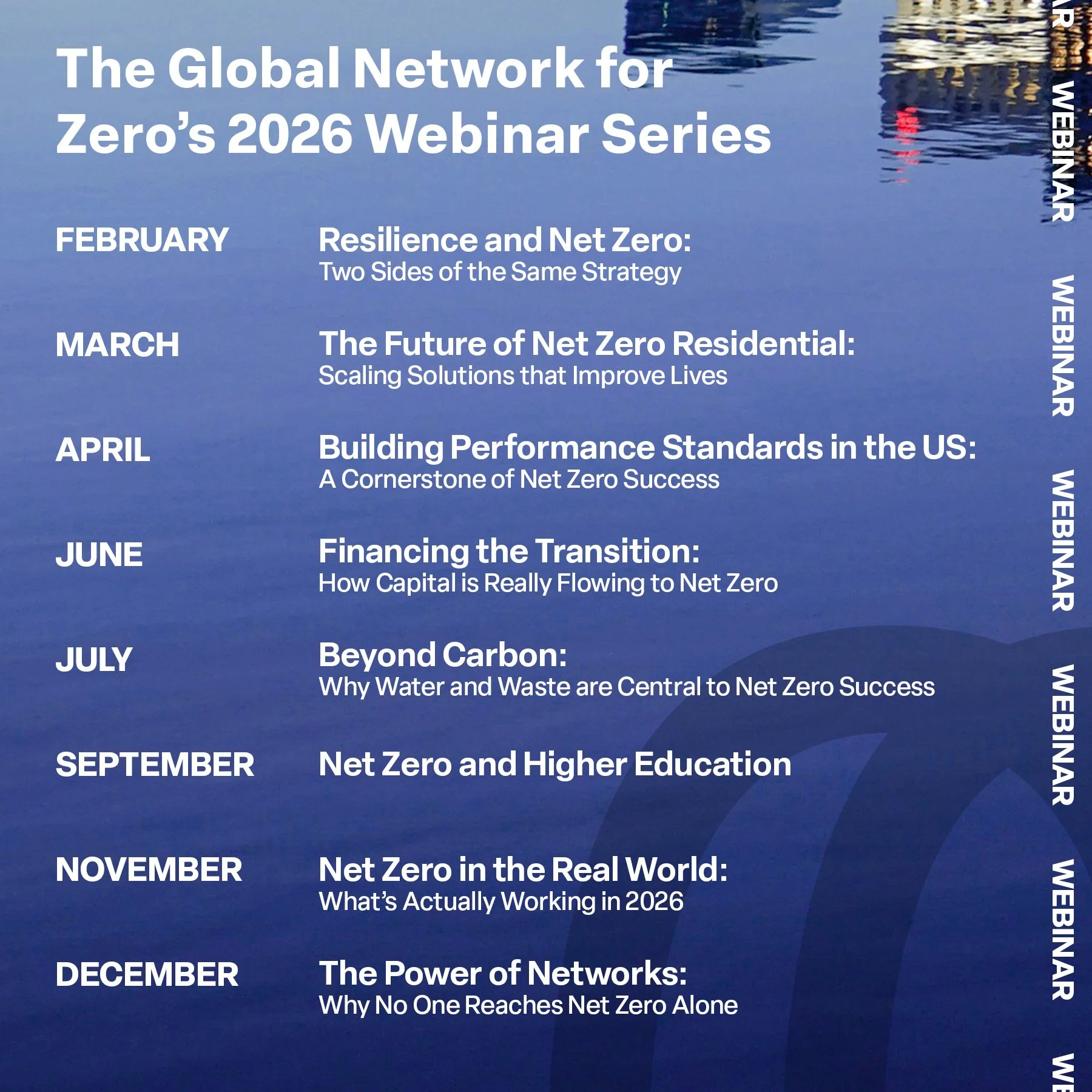
In 2026, the GNFZ Webinar Series will convene leaders across policy, finance, design, operations, and technology to tackle real-world implementation challenges — from performance standards to financing, water, waste, and sector-specific case studies.
Register for free and engage with the global net-zero community: https://www.globalnetworkforzero.com/insights/building-the-future-of-net-zero-the-global-network-for-zeros-2026-webinar-series
Why This Matters — and Why We Built GNFZ
Net zero has entered its execution phase. The organizations that succeed will be those that measure rigorously, act incrementally, and learn collectively.
GNFZ exists to make that possible by lowering barriers, aligning frameworks, validating progress, and building a global network focused on doing, not just declaring. If you’re ready to move from commitments to outcomes, join GNFZ and help define what credible net zero looks like in practice.