
Sustainable Finance and Impact Investing: Raising the Expectations for Net Zero Buildings
The question is no longer whether capital is green
Sustainable finance has entered a different phase. For years, much of the conversation was focused on defining what qualifies as green taxonomies, ESG frameworks, and financial instruments that could channel capital towards sustainable activities. Those foundations remain important. But the conversation is now becoming more demanding.
The question is increasingly moving from “Where is the capital going?” to “What is the capital actually achieving?” This distinction matters. A sustainable investment cannot be meaningful simply because it carries a green label or aligns with a sustainability framework. Investors, lenders and asset owners increasingly need to understand the environmental outcome associated with the capital deployed: how that outcome is measured, whether it is independently verified, and whether it can be sustained over time.
This is particularly relevant for the built environment. Buildings are long-term assets, and the decisions made around their design, construction, financing and operation can influence energy consumption, carbon emissions, operating costsand asset resilience for decades. That creates a significant opportunity for sustainable finance and impact investing to move the conversation around buildings from green credentials to measurable performance.
From green finance to impact investing
The evolution of sustainable finance has been important. Green finance created mechanisms to direct capital towards projects with environmental benefits. ESG investing broadened the lens through which investors consider environmental, social and governance factors. Sustainable finance has continued to expand the range of instruments and activities that can be financed.
Impact investing takes the conversation a step further. It asks not only whether an investment considers sustainability, but whether it is contributing to a measurable and intentional positive outcome alongside financial returns. That distinction is highly relevant to buildings.
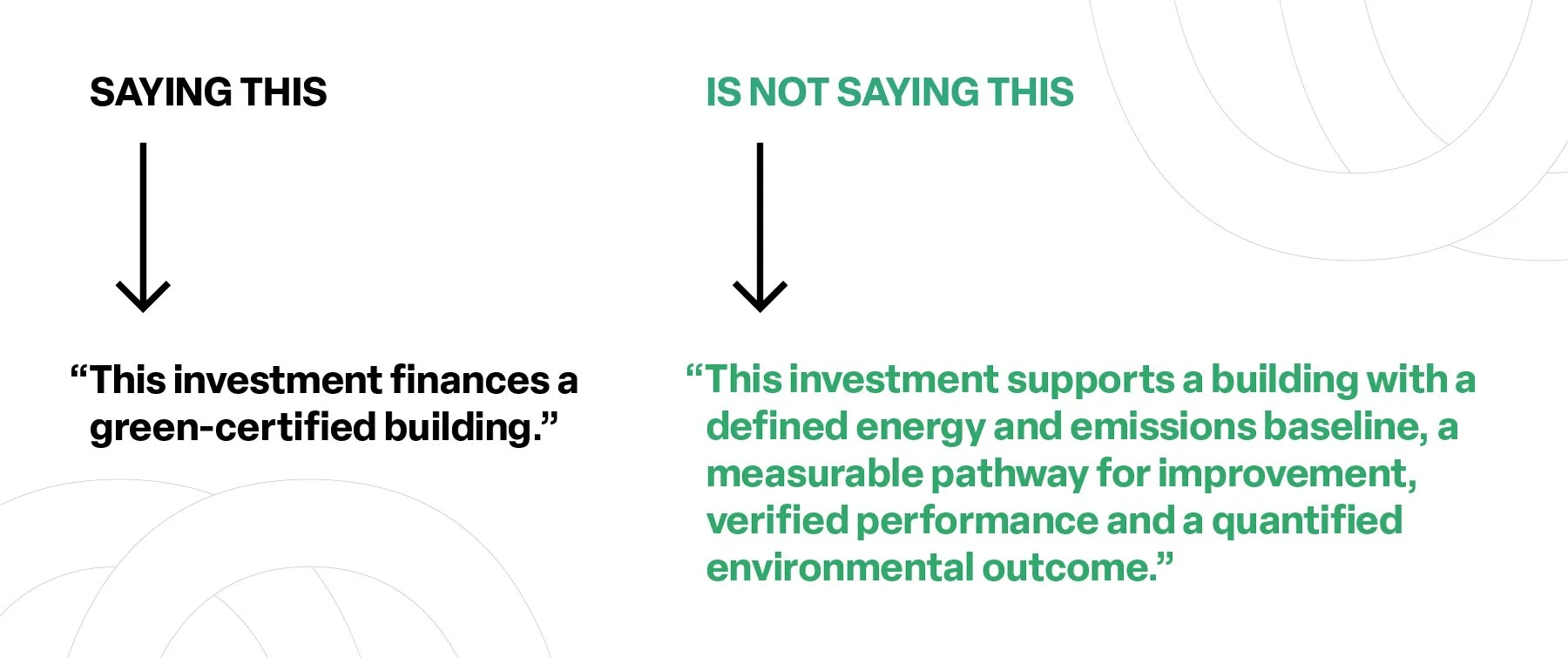
The second statement gives investors a much clearer connection between capital, intervention and impact. This is where I believe the next opportunity lies.
When sustainability becomes an investment question
Sustainability and financial performance can no longer be treated as separate conversations. For a long-term real-estate asset, energy consumption influences operating expenditure. Carbon performance influences transition risk. Building resilience influences long-term asset value. Energy efficiency influences tenant expectations and competitiveness.
These relationships do not mean that every sustainable intervention automatically creates a financial return, nor should environmental impact be reduced to a financial metric. But they do demonstrate why sustainability performance increasingly belongs inside investment decision-making. The financial sector is already recognising that broader connection: the OECD’s 2026 review notes that climate-related financial policies have continued to expand globally, with policymakers increasingly integrating climate considerations into financial-sector policy and risk management.
The next question is therefore not simply how much sustainable capital is available. It is how intelligently that capital can be deployed to create measurable transition and environmental outcomes.
The credibility challenge: Beyond the green label
As sustainable finance grows, credibility becomes increasingly important. The market has learned that a sustainability label, by itself, does not tell the complete story. A project may have a green designation. A building may have a certification. An instrument may be linked to sustainability targets. Investors still need to understand what the baseline is, what is changing, how material that change is, how it is measured, who verifies it, and what happens if the intended outcome is not achieved.
These questions are becoming more pressing as sustainable finance moves from voluntary ambition towards stronger market infrastructure and oversight. In 2026, sustainable finance discussions have increasingly focused on implementation, external review, disclosure quality and market integrity rather than simply creating new frameworks. India is moving in the same direction: SEBI revised its norms in February 2026 concerning independent third-party reviewers and certifiers for green debt securities, reflecting the importance of credibility and external assessment in sustainable debt markets.

Why independent verification matters
If the quality of evidence is now as important as the claim, then who produces that evidence matters as much as what it says. Self-assessed claims, however well-intentioned, leave investors taking the outcome on trust. This is the problem the Global Network for Zero was set up to solve. As an independent, third-party certification body, GNFZ certifies net zero on measured performance rather than projections, so every claim has been checked by someone with no stake in the outcome. That is evidence an investor can rely on, and one a lender can write into a covenant.
Why buildings are a critical test for impact investing
The built environment is an interesting test case for this evolution. Buildings require significant upfront capital and have long operating lives, so their environmental performance is shaped by decisions made long before the asset begins generating operational data. At the same time, buildings are not static. A building that performs well on paper can perform differently once occupied: energy-use patterns change, occupant behaviour changes, systems may not operate as intended, maintenance practices evolve, energy sources change.
This creates an important distinction between design intent and operational reality and that distinction matters to finance. If capital is being allocated because an asset is expected to deliver environmental benefits, investors should ultimately be able to understand whether those benefits are being realised. This is where net-zero buildings become particularly relevant.
This is where GNFZ certification makes the difference. Certification is not awarded once and filed away: certified buildings resubmit their measured energy and emissions data every year to stay certified. Over time, that builds a multi-year performance record for each asset showing whether savings have held, where performance has drifted and how the building responds to changes in occupancy, operation and energy supply. Because every year’s data is independently verified rather than self-reported, that record becomes something an investor can underwrite against and a lender can link to financing terms. Years of verified data turn a single impact claim into a track record and a track record is what turns design intent into proven operational performance.
From financing green buildings to financing building performance
I believe the next stage of sustainable finance in real estate should place far greater emphasis on actual building performance. Certification and design-stage assessment remain valuable — they create common frameworks, establish expectations and help investors understand the sustainability characteristics of an asset. But they should be viewed as part of a longer journey. A stronger investment approach would connect the full chain from capital to the sustainability intervention it funds, to the building’s actual performance, to a measured environmental outcome, to independent verification of that outcome and, ultimately, to long-term impact.
This creates a much stronger relationship between finance and the real economy. The question changes from “Was the building designed to be sustainable?” to “Is the building actually delivering the environmental performance the investment was intended to support?” That is a far more meaningful question for impact investing and it is the question GNFZ certification is built to answer, because certified assets must resubmit their performance data every year to stay certified.
The importance of transition finance
There is another dimension to this discussion. The future of sustainable finance cannot be limited to financing assets that are already green. If the objective is economy-wide decarbonisation, we also need to finance transition. For buildings, that means looking beyond new developments to the enormous existing stock assets with high energy consumption, inefficient systems, significant retrofit requirements, limited renewable integration, or a large gap between current performance and a credible net zero pathway.
The investment opportunity is therefore not simply “build a new net zero building.” It is also: how can capital enable an existing building to transition? India’s 2026 work on financing the net zero transition explicitly identifies the need for credible transition pathways, verified plans, financing innovation and mechanisms that bridge the gap between current assets and future climate objectives. For the built environment, that could mean financing deep energy retrofits, electrification, renewable energy, building controls, efficiency improvements and other interventions that move an asset along a credible performance pathway.
This is where GNFZ’s incremental pathway is designed to help. It recognises each step of an existing building’s transition a verified emissions assessment, a net zero plan, measured reductions against milestones with no prerequisites to enter. Owners gain evidence to show investors long before the asset reaches net zero, and lenders gain defined points to tie capital to.
India as a model for other markets
India offers a useful model for other fast-growing economies not because it has solved the problem, but because it is facing every part of it at once: rapid urbanization, a building stock that is still largely to be built, and fast-rising demand for sustainable capital. What is happening in Indian real estate is a preview of the choices many emerging and mature markets will face over the next decade.
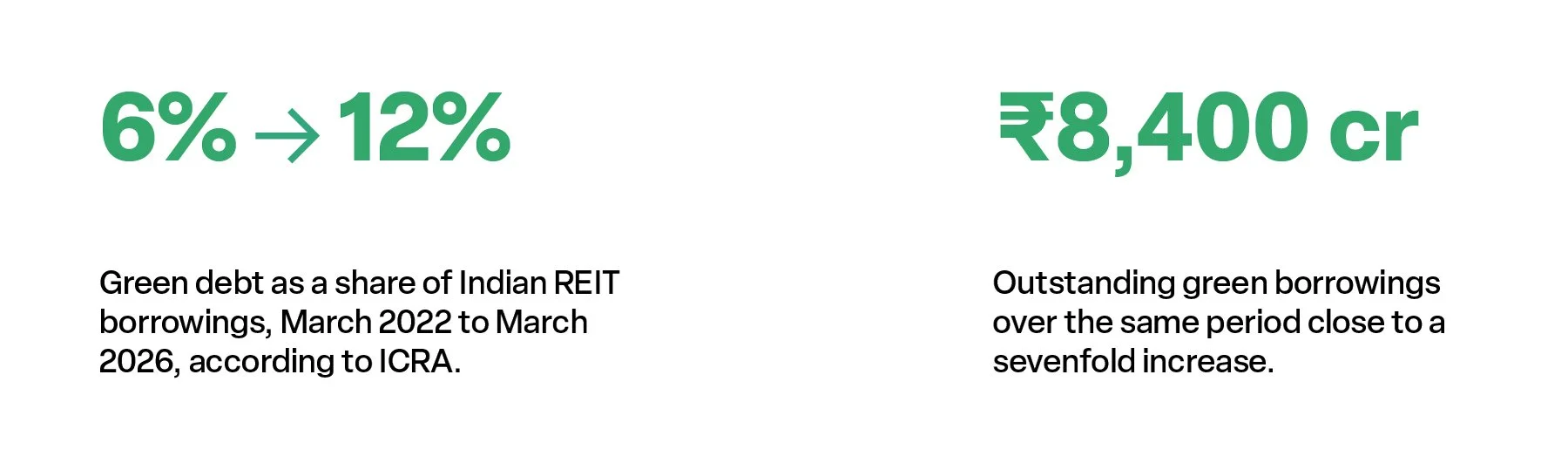
That growth is encouraging. But it raises the question every market will eventually have to answer: as the volume of sustainable capital increases, do the expectations around measurable building performance increase at the same pace? I believe they should.
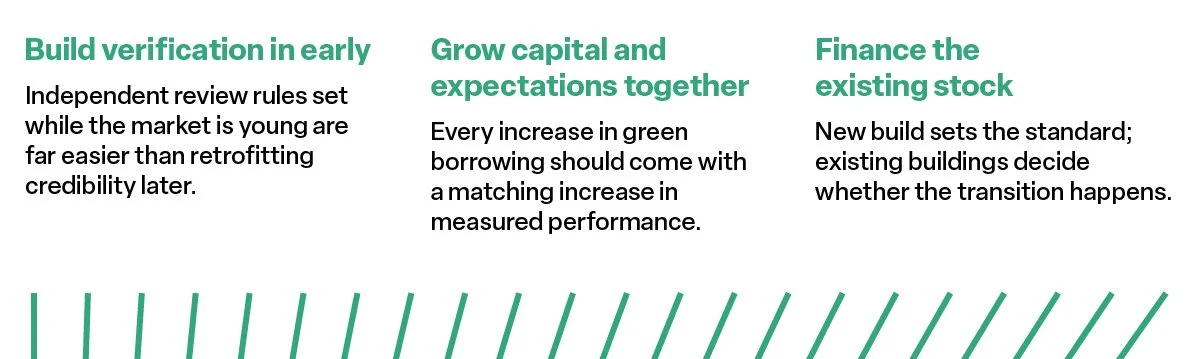
India’s ecosystem is also showing a sequence other markets can follow. Regulators are strengthening external review of green debt, and attention is turning to disclosure, investor stewardship and transition-finance classification highlighted as next-stage policy questions in PRI’s 2026 assessment of India’s landscape. Three lessons travel well:
What should investors be asking?
If impact is going to become a stronger part of sustainable investment, the questions investors ask will need to evolve. For a building or a real-estate portfolio, I would expect the conversation to increasingly include:
What is the current performance baseline?
What environmental outcome is the investment intended to create?
What intervention will create that outcome?
Is the target measurable and material?
What methodology is being used?
How will actual performance be monitored?
Who will verify the results?
What happens if the target is not achieved?
Is the asset capable of continuing to improve over time?
And perhaps most importantly: does the investment create a credible pathway towards net zero, or does it simply meet today’s definition of “green”? These are not questions that belong only to investors. They are increasingly relevant to developers, asset owners, lenders, designers, operators and sustainability professionals.
Where certification has to evolve
At the Global Network for Zero, this is the gap our certification was designed to close. GNFZ certification is not a design-stage label. It is a performance pathway that follows the same chain investors need to see — from baseline to verified outcome — and it proceeds in four stages rather than a single pass-fail exercise:
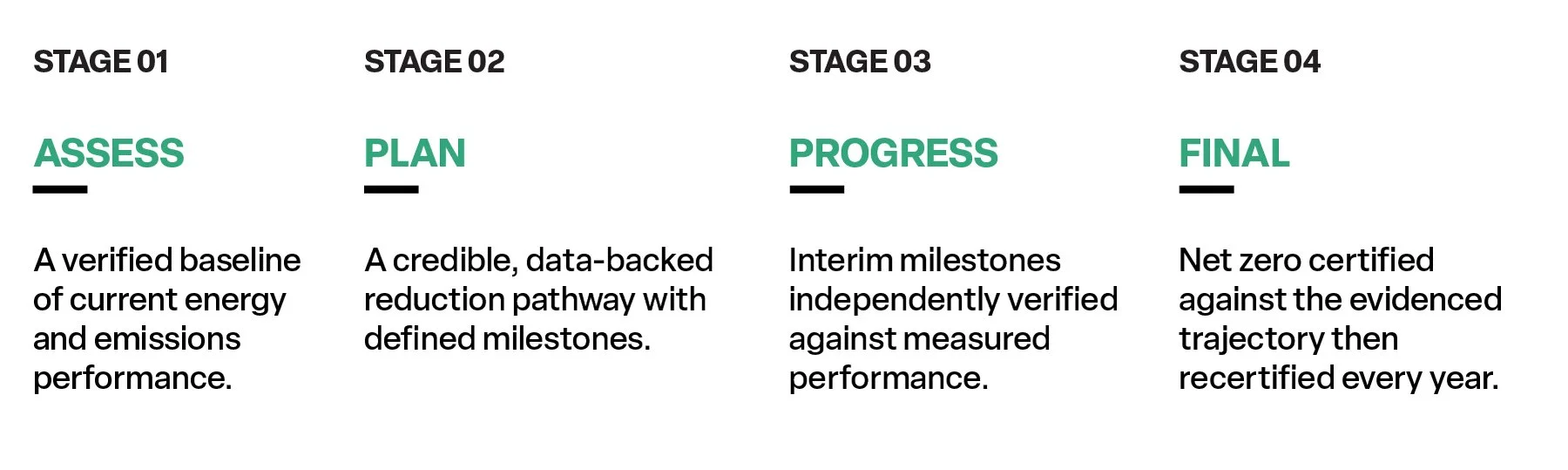
Read against the nine questions above, each stage answers a part of them: the baseline at Assess; the intended outcome and the intervention at Plan; measurable targets, methodology, monitoring and verification at Progress; and, through annual recertification at Final, a yearly answer to what happens if performance slips and whether the asset keeps improving.
Two design choices matter particularly for finance. First, physical energy and emissions performance is assessed and disclosed separately from market-based instruments such as renewable energy certificates and offsets, so the operational result is never obscured. Second, results are benchmarked against the reference points institutional climate finance already uses Paris-aligned pathways, the GHG Protocol and relevant ISO standards so asset-level evidence speaks the same language as portfolio-level commitments.
There are also no prerequisites. An existing building with a high baseline can enter at Plan and finance its transition against milestones a lender can underwrite. That is transition finance in practice: the first project certified under our Net Zero for Existing Buildings certification SRK Exports’ crafting facilities in Surat, India reached net zero in 2024, six years ahead of its original 2030 target.
The net zero building as an impact asset
This brings us back to the building itself. A net zero building should not be viewed simply as a technical achievement; it can also be viewed as an impact asset, whose value proposition encompasses financial performance, environmental performance, resilience and long-term transition readiness.
But that requires a shift in mindset. A net-zero claim should not be the end point. It should be supported by a transparent methodology, a credible baseline, measurable targets, appropriate boundaries, reliable data and ongoing verification. Most importantly, the building needs to perform.
The same constraint appears across markets. In India, recent work by the Global Green Growth Institute highlights that access to finance remains a significant constraint on scaling low-carbon buildings, despite strong policy and regulatory foundations. That tells us something important: the challenge is no longer only technological. It is financial, institutional and performance related.
Raising the expectations
This is where I believe the next chapter of sustainable finance needs to go: From green labels to measurable impact. From commitments to demonstrated outcomes. From design intent to operational performance. From financing new green assets to financing transition. From reporting metrics to understand what capital changes. From financing green buildings to financing credible pathways to net zero.
None of this diminishes the importance of certification, ESG disclosure or green-finance frameworks. It strengthens their purpose. The role of sustainable finance should ultimately be to direct capital towards outcomes that matter and to create enough transparency and accountability for investors to understand whether those outcomes are being achieved.
The opportunity for impact investing is therefore much larger than creating another category of sustainable assets. It is about connecting financial capital with real-world transformation and buildings provide one of the clearest places to demonstrate that connection.
The question for the next generation of sustainable finance
Are we financing buildings because they are labelled green — or because they can demonstrate measurable progress towards a net zero future? For me, that is the shift that will define the next stage of sustainable finance in the built environment. Because ultimately, sustainable finance should not only ask where our money goes. It should increasingly ask what our money changes. Underwriting, developing or operating buildings? Start with a verified GNFZ baseline and build a net zero pathway your investors can follow and verify.