
Dispatches in Decarbonization: Are We Making Net Zero Too Complicated? Organizations Need Fewer Barriers, Not More Frameworks

This article first appeared in Mahesh Ramanujam’s monthly LinkedIn newsletter, Dispatches in Decarbonization, on September 16, 2026. Subscribe on LinkedIn to receive these updates.

Over the last decade, the net zero movement has matured dramatically. This is unquestionably a good thing. We have better climate science, stronger standards, more sophisticated accounting methods and regulations creating real accountability. Governments, investors, businesses and communities increasingly understand that net zero cannot remain a distant aspiration or a problem pushed to future generations. It must become a measurable business strategy supported by credible data and verifiable performance.
But this progress has produced an unintended consequence: The journey to net zero has become increasingly difficult to navigate. Today, an organization beginning its decarbonization work may encounter the GHG Protocol; ISO standards; the Science Based Targets initiative (SBTI); ESG reporting requirements; green building certifications; local building performance standards; Scope 1, 2 and 3 accounting; renewable-energy procurement; embodied carbon; carbon credits and removal strategies and more.
It can be an overwhelming landscape especially for organizations without large sustainability teams or significant consulting budgets.
The question many leaders are asking is no longer, “Which framework should I follow?” It is, “What do I need to do next?” That is the question our industry must answer.
Complexity Is Slowing Progress
The climate challenge is urgent, but the pathway presented to organizations is often anything but clear.
Too many businesses spend enormous amounts of time interpreting requirements, reconciling methodologies and transferring information among disconnected systems. Energy, emissions, water and waste data may all sit with different teams or vendors. Supply-chain data may be incomplete or unavailable altogether.
Even organizations committed to acting can struggle to establish a reliable starting point. This burden is particularly significant for small and medium-sized businesses, nonprofits, schools, local governments and organizations in emerging markets. They may have the ambition to act but lack the in-house expertise needed to navigate an expanding universe of standards and acronyms.
The result is analysis-paralysis. Organizations fear selecting the wrong methodology, setting the wrong target or reporting imperfect data. Some spend years building inventories and strategies without implementing them. Others decide that net zero is too expensive or complicated and never begin.
This is not the outcome we need. To be clear, the world doesn’t need fewer standards. Standards are essential as they create consistency, comparability and trust. However, organizations do need a simpler way to connect those standards to action.
As I have said throughout my career, reducing friction is key to accelerating adoption. Every unnecessary barrier limits participation, and every organization left on the sidelines represents emissions, waste and inefficiency that continue unchecked.
While we cannot lower the level of rigor, we can lower the barriers to achieving it.
A Simpler Model for Action
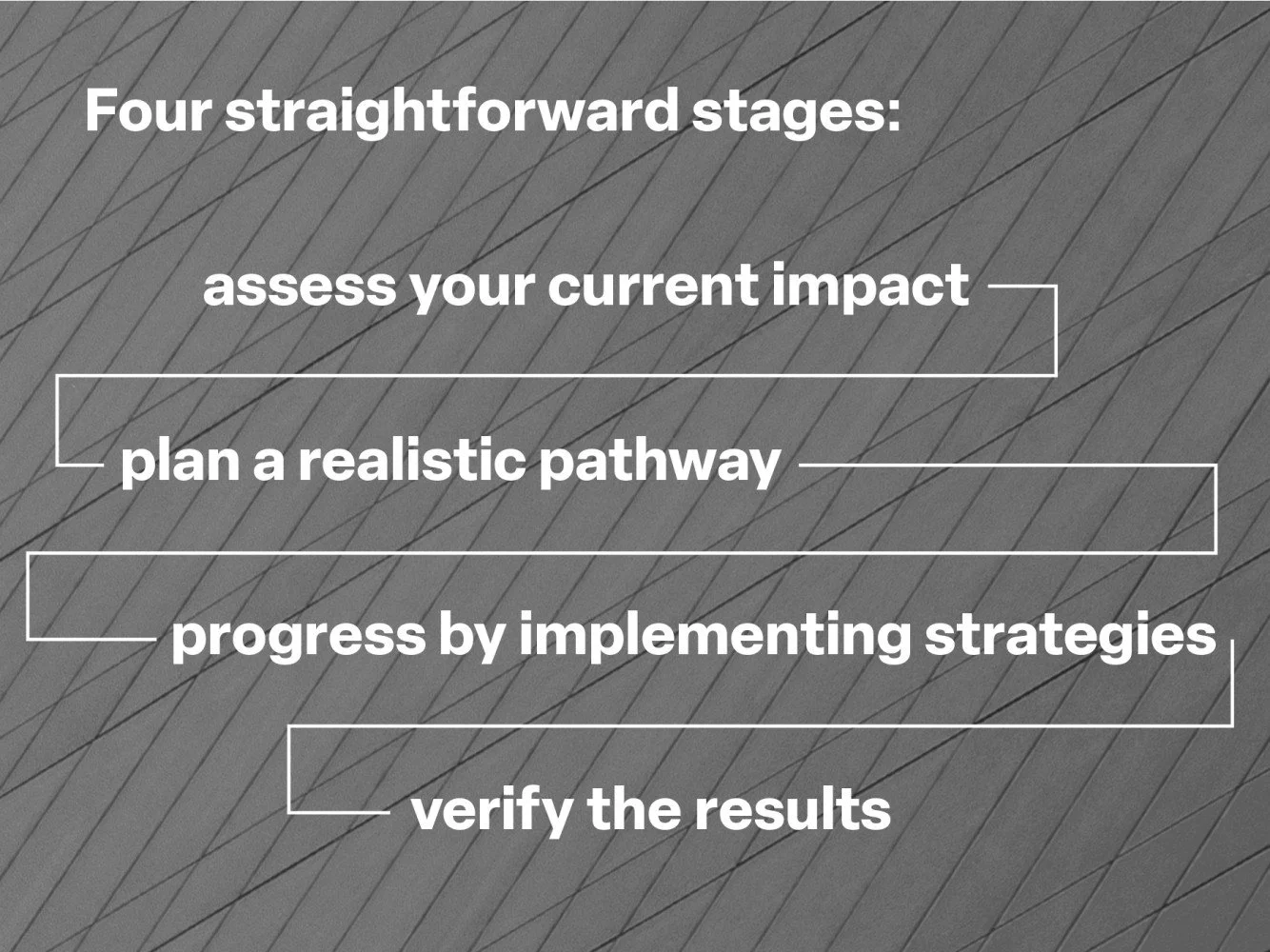
At GNFZ, we have always believed that net-zero should be an incremental, flexible and affordable performance journey, not an all-or-nothing exercise. That journey follows four straightforward stages: Assess your current impact, plan a realistic pathway, progress and improve by implementing your strategies, and verify the results and achieve certification.
Assess
Before setting a target, an organization must honestly understand its starting point and the baseline it seeks to improve. That means developing an accurate accounting of Scope 1, Scope 2 and Scope 3 emissions ,while also gathering the underlying energy, water, waste and operational data needed to establish a credible baseline.
This does not mean every piece of data must be perfect on day one. It means organizations must begin to measure, identify gaps and improve data quality over time.
The GNFZ platform is based on the Greenhouse Gas Protocol (GHG Protocol) and was designed with the familiar logic of a spreadsheet. Organizations can bring information together in one accessible place without having to master an entirely new technical environment or juggle multiple methodologies and disconnected systems.
A proper assessment turns ambition and net zero strategies into math. It tells an organization where its greatest impacts are, where the most significant opportunities exist and which actions should come first.
Plan
Once an organization understands its starting point, it can create a realistic pathway forward. A credible net zero plan should prioritize high-impact actions, establish interim milestones and connect sustainability investments to operational and financial outcomes. It must reflect the organization’s actual assets, resources, geography and business model — not an idealized pathway created for someone else.
Not every organization can achieve net zero immediately, but every organization can determine its next measurable step. This is why the GNFZ process does not impose unnecessary prerequisites or demand a costly, all-at-once transformation. We meet organizations where they are and help them establish a practical pathway from awareness to action and, ultimately, verified performance.
Progress and Improve
A plan has value only when it’s implemented. This is the stage where organizations improve efficiency, procure renewable energy, electrify equipment, reduce water consumption, divert waste, engage suppliers, transform employee travel and commuting, and address the wider impacts across their value chains.
It is also where incremental recognition matters – GNFZ offers milestone certificates whenever requested, so projects can celebrate the progress they are making towards net zero along the way publicly. Some organizations going through GNFZ certification choose to apply for these annually to demonstrate the percentage of progress they are making on a yearly basis against their plans. Others pursue recognition after completing a specific intervention so they can quantify to their boards, shareholders, customers and more how those investments translated into measurable reductions.
That level of visibility is critical. In more generalized sustainability systems, it can be difficult to determine how a particular strategy affected emissions or resource consumption. A performance-based process allows an organization to directly connect the action to the outcome – and that makes all the difference.
It is a well-known adage that progress creates momentum. It gives employees something tangible to support, gives leaders evidence that investments are working and gives investors, customers and communities credible information they can trust.
Verify
The final step is independent third-party certification and verification. Verification demonstrates that reported outcomes are supported by evidence. It replaces generalized claims with credible results and protects organizations from accusations of greenwashing.
Final certification, however, should not be understood as the end of the journey. Net zero is not a single project or a one-time achievement. It is a continuous process of measurement, action and improvement. That’s why in order to maintain GNFZ certification, organizations must resubmit their performance data every year.
What We Have Learned at GNFZ
One of the most consistent pieces of feedback we hear from organizations using the GNFZ platform is remarkably simple: “You have made this understandable.”
That matters because organizations are not asking for another acronym, another framework or another reporting exercise. They are simply asking for clarity about how to get started.
Our certification platform brings energy, emissions, water and waste into one connected process. It accommodates local policies, emissions factors and carbon coefficients while maintaining a consistent foundation for accounting and verification.
Most importantly, it is designed to reward progress. We did not build GNFZ to create another layer of complexity. We built it to connect the many pieces of net zero into a pathway people can actually follow.
Proof That Simplicity Accelerates Action
Shree Ramkrishna Exports Pvt. Ltd., or SRK, offers a powerful example.
Based in Surat, India, SRK is one of the world’s leading diamond-crafting companies. Sustainability was not new to the organization. SRK had already implemented significant environmental and social initiatives. But bringing those efforts together into a comprehensive, measurable net zero strategy required a clear framework and process.
Early in our work together, the conversation included the possible use of offsets. We encouraged SRK first to identify direct reductions and permanent removal strategies it could implement. The objective was not simply to balance a carbon ledger. It was to change performance.
The company invested in a 6-megawatt solar installation, financed entirely by SRK, with an anticipated payback period of approximately six to seven years and which completely mitigated their Scope 1 and 2 emissions. It also pursued electric-vehicle adoption, employee-commuting initiatives, land restoration and tree planting while completing detailed Scope 1, 2 and 3 emissions accounting.
Acesss SRK's Case Study to Learn More →
Those actions produced measurable results. In 2024, SRK House and SRK Empire became the first buildings to achieve GNFZ Net Zero Operations: Emissions and Energy certification. They reached this milestone six years ahead of SRK’s original 2030 target and decades ahead of India’s national net zero timeline. The company is now extending this work across water and waste.
A Call for Simplicity
Thousands of organizations have made commitments, established targets and acknowledged the urgency of climate action. The challenge now is helping them move from pledges to measurable performance.
If we are serious about decarbonization at scale, we must move beyond intent, beyond design and into performance. Buildings and businesses do not operate on intent. They operate through energy systems, procurement decisions, supply chains and day-to-day choices.
Organizations do not need more reasons to wait. Our responsibility as an industry is to give them a clear answer and a practical pathway to get started today.
Interested in learning more about GNFZ certification? Reach out to our team.