
BRICS Backs Carbon Market Cooperation, Pushes Back on Unilateral CBAM: What it Means for Net Zero Pathways

At the 18th BRICS Summit held in New Delhi on September 12, 2026, member nations adopted the New Delhi Declaration, formally endorsing deeper cooperation on carbon markets while firmly rejecting unilateral carbon border adjustment mechanisms (CBAMs) imposed by the European Union and the United Kingdom. For organisations navigating the intersection of decarbonization strategy and international trade, the declaration signals a widening gap between how emerging and developed economies want climate policy and trade policy to interact — and it underscores why credible, verifiable emissions data is becoming a competitive asset rather than a compliance afterthought.
A Formal Push for Carbon Market Cooperation
The New Delhi Declaration commits BRICS countries to greater cooperation on carbon markets, centred on capacity building and the exchange of technical expertise. Central to this is the BRICS Carbon Markets Partnership, a memorandum of understanding aimed at supporting national climate strategies, complementing mitigation efforts, and mobilizing climate finance across member states. Notably, the declaration also opens a dialogue on aligning carbon markets with adaptation goals — extending the conversation beyond emissions reduction and pricing into resilience and adaptive capacity and linking it explicitly to the debt sustainability and fiscal space challenges facing many developing economies.
This is a meaningful shift: rather than treating carbon pricing purely as a compliance mechanism imposed from outside, BRICS nations are positioning it as a tool they intend to shape on their own terms.

Figure 1: The four core pillars of the BRICS Carbon Markets Partnership as set out in the New Delhi Declaration.
The CBAM Flashpoint
The declaration's language on trade is remarkably clear: BRICS members object to unilateral, punitive, discriminatory, and protectionist climate-linked trade measures, and they explicitly name CBAM as an example. The concern, echoed by policy analysts, is that such mechanisms risk placing disproportionate costs on developing countries and could constrain their ability to build climate resilience and adaptive capacity even as those countries work to decarbonise.
This tension is not by any means theoretical. The EU's definitive CBAM regime took effect on January 1, 2026, covering cement, iron and steel, aluminium, fertilisers, electricity, and hydrogen imports. The UK will introduce its own CBAM from January 1, 2027. Both require exporters to account for embedded carbon in their products and demonstrate what carbon price, if any, was already paid at origin.
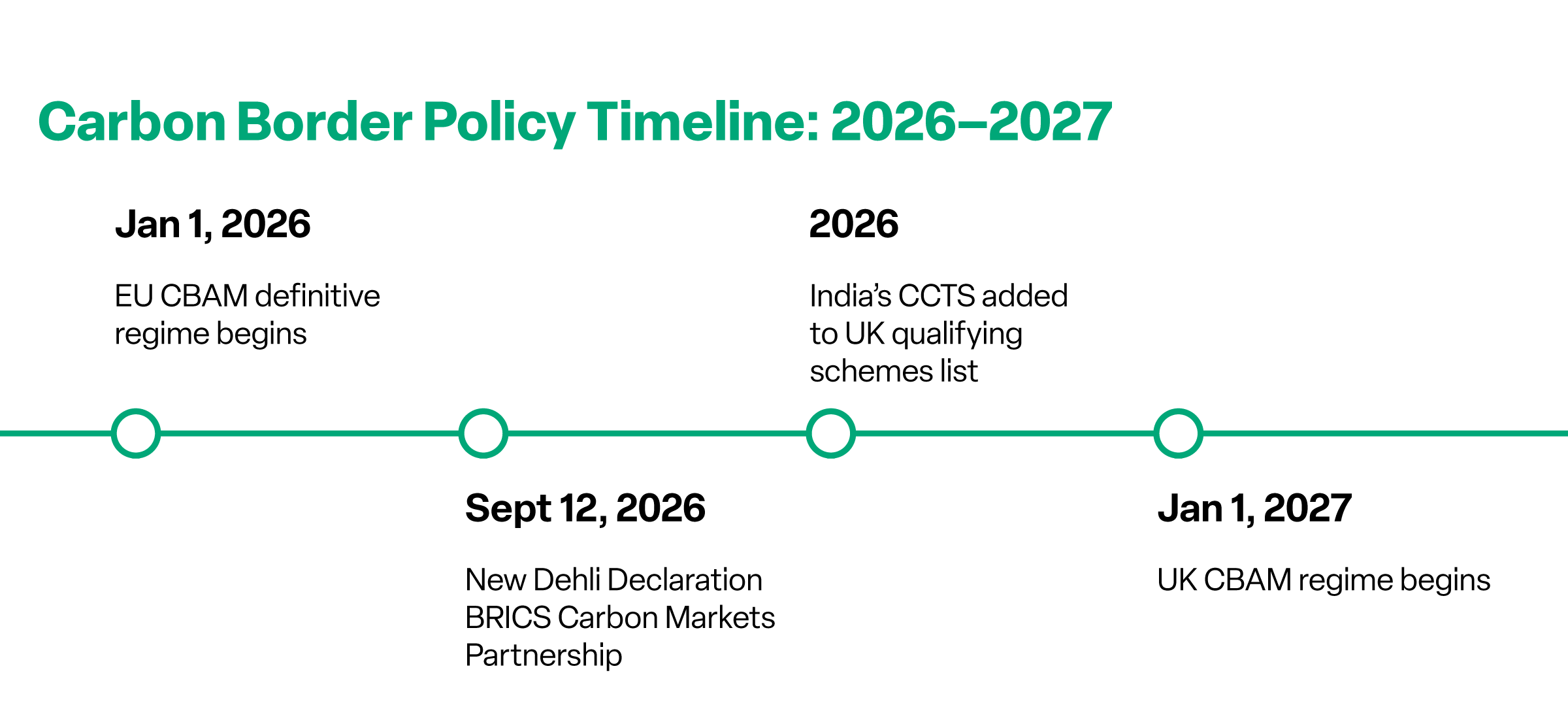
Figure 2: Key carbon border policy milestones, 2026–2027.
India's CCTS Gains Recognition — With Caveats
One of the more consequential developments buried within this broader story is that India's Carbon Credit Trading Scheme (CCTS) has been added to the UK's list of qualifying overseas carbon pricing schemes. In principle, this allows carbon prices paid under India's domestic scheme to be factored into UK CBAM liability calculations, reducing the risk of Indian exporters being charged twice for the same embedded carbon.
In practice, the near-term financial benefit is likely to be modest, since India's carbon price under CCTS remains well below the UK’s. The greater significance lies in precedent: formal recognition gives India's carbon pricing architecture standing within an emerging global regime, credibility that can compound as the domestic market matures.
Recognition is also narrower than it might first appear. The UK framework distinguishes between qualifying carbon pricing and other forms of carbon credits or offsets, and it requires verifiable evidence of the carbon price paid and the emissions it relates to. A recognised scheme is not a blanket exemption — it is a data and verification requirement dressed up as a trade concession.
Why Measurement and Verification Now Matter More Than the Carbon Price Itself
For micro, small, and medium enterprises (MSMEs) — a backbone of manufacturing supply chains across India — the immediate benefit of CCTS recognition is limited, since the scheme currently focuses on large, energy-intensive installations. Those embedded in export-facing supply chains face a more pressing challenge: not the carbon price, but the ability to measure, report, and verify emissions data to the standard border regimes now demand.
This is precisely where the conversation shifts from geopolitics to operational reality. As carbon border measures proliferate, the ability to produce audit-ready, standards-aligned emissions data — at the asset level, not just the corporate aggregate — becomes the difference between capturing export competitiveness and absorbing avoidable border costs.
GNFZ's View
At Global Network for Zero, we see this development as further validation of the direction our certification methodology has taken from the outset. Our Net Zero framework — spanning Energy, Emissions, Water, and Waste — is built around asset-level, auditable data because that is precisely the granularity that emerging trade and carbon-market regimes are beginning to demand. Certification frameworks like ours are not positioned as a substitute for national carbon pricing schemes or international climate agreements; rather, they are a practical complement — giving asset owners, developers, and exporters the verifiable, globally benchmarked data trail that policy frameworks like CBAM and CCTS increasingly require to function.
As carbon markets, adaptation finance, and border trade measures continue to interconnect — as this BRICS declaration makes clear they will — the organisations best positioned to benefit will be those that treated rigorous, independently verified emissions accounting as a strategic asset well before it became a trade necessity.
