

This article first appeared in Mahesh Ramanujam’s monthly LinkedIn newsletter, Dispatches in Decarbonization, on June 10, 2026. Subscribe on LinkedIn to receive these updates.

A May 2026 Gallup survey found that 71% of Americans oppose building AI data centers in their communities. Remarkably, Americans are now more opposed to a nearby data center than a nearby nuclear power plant – by nearly 20 percentage points!
Think about that for a moment.
While governments and corporations are investing hundreds of billions to accelerate the AI revolution, the public is pushing back on the infrastructure required to power it. That tension may become one of the defining sustainability challenges of this decade.
For most of my career, I have worked at the intersection of sustainability and technology. For over a decade, I held leadership positions at IBM and Lenovo, where I led several business transformation programs. Then, at the U.S. Green Building Council, I helped transform the organization into a truly digital enterprise, modernizing how building performance data was collected, analyzed, and deployed at global scale. And today, at the Global Network for Zero (GNFZ), I continue to focus on a simple belief: Data, measurement, and technology are essential to achieving meaningful climate progress.
That is why I have been fascinated to watch the rapid rise of AI.
Few technologies have generated as much excitement and uncertainty. While it promises unprecedented gains in productivity, innovation, and efficiency, we must confront a critical question: How do we power the AI revolution in a way that advances our climate goals rather than undermines them? The answer increasingly points to data centers.
The Backbone of the New Economy
Once viewed as largely invisible, data centers are facing growing scrutiny as communities weigh their economic benefits against their environmental impacts.
Data centers have long served as the backbone of the digital economy. They have long been the backbone of the digital economy; now, they are the backbone of the AI economy. Every large language model, machine learning application, digital assistant, predictive analytics platform, and AI-powered business tool relies on massive computing infrastructure operating behind the scenes.
Demand for capacity is growing at an extraordinary pace. I see this firsthand living in Virginia – home to the largest concentration of data centers in the world. Virginia hosts roughly 35% of global hyperscale data centers and approximately 13 to 14% of worldwide operational data center capacity, and an estimated 70% of global internet traffic passes through infrastructure located in the state.
According to the International Energy Agency, data centers consumed approximately 415 terawatt-hours of electricity in 2024. By 2030, that figure could more than double to 945 terawatt-hours – roughly equivalent to Japan's entire annual electricity consumption. In 2025 alone, data center electricity demand grew by an astonishing 17%.
This explosive growth presents both a tremendous opportunity and a significant challenge.
The Opportunity: Infrastructure for Decarbonization
It’s important to recognize that digital infrastructure is not the enemy of sustainability.
In fact, some of our most promising climate solutions depend on it. AI is already helping organizations optimize building performance, improve energy management, forecast renewable energy production, reduce waste, streamline logistics, and identify operational efficiencies that would otherwise remain hidden. Utilities use it to integrate renewable energy into complex grids, while scientists rely on it to accelerate breakthroughs in clean technology.
Data centers shouldn’t be viewed simply as energy consumers. They are increasingly becoming the infrastructure that enables decarbonization itself.
The Challenge: Earning the Social License
On the flip side, data centers consume significant energy, water, and materials – and communities are taking notice. A recent Washington Post poll found that only 35% of Virginians are comfortable with a new data center being built in their community. Concerns range from electricity demand and water consumption to land use, noise, and rising utility costs. What was once viewed as benign digital infrastructure is increasingly being treated like any other major industrial development.
A modern data center facility can require tens of megawatts of power to operate. Cooling systems alone often account for a substantial portion of overall energy consumption. Water usage is becoming an equally important issue, especially in regions facing water stress.
Meanwhile, the rapid pace of technological advancement creates additional challenges around embodied carbon and electronic waste. Servers, networking equipment, batteries, and cooling systems all carry significant environmental footprints across their lifecycle.
This reality is attracting growing attention from regulators, investors, customers, and citizens. Globally, governments are introducing new sustainability expectations, permitting requirements, and environmental performance standards for data center developments.
In many markets, future growth no longer depends solely on technical capability or capital; it depends on earning a social license to operate. Organizations that can prove measurable environmental performance will secure public trust and accelerate project delivery.
The question is no longer whether data centers can support digital growth, but whether they can do so sustainably.
The Next Generation: Resource Intelligence
The good news is that many of the solutions already exist, including at GNFZ. Leading operators understand that sustainability and operational performance are no longer competing priorities.
The industry is also moving beyond a single metric such as Power Usage Effectiveness (PUE). While energy efficiency matters, it tells only part of the story. The data centers of the future must address four interconnected dimensions simultaneously: Energy, emissions, water, and waste.
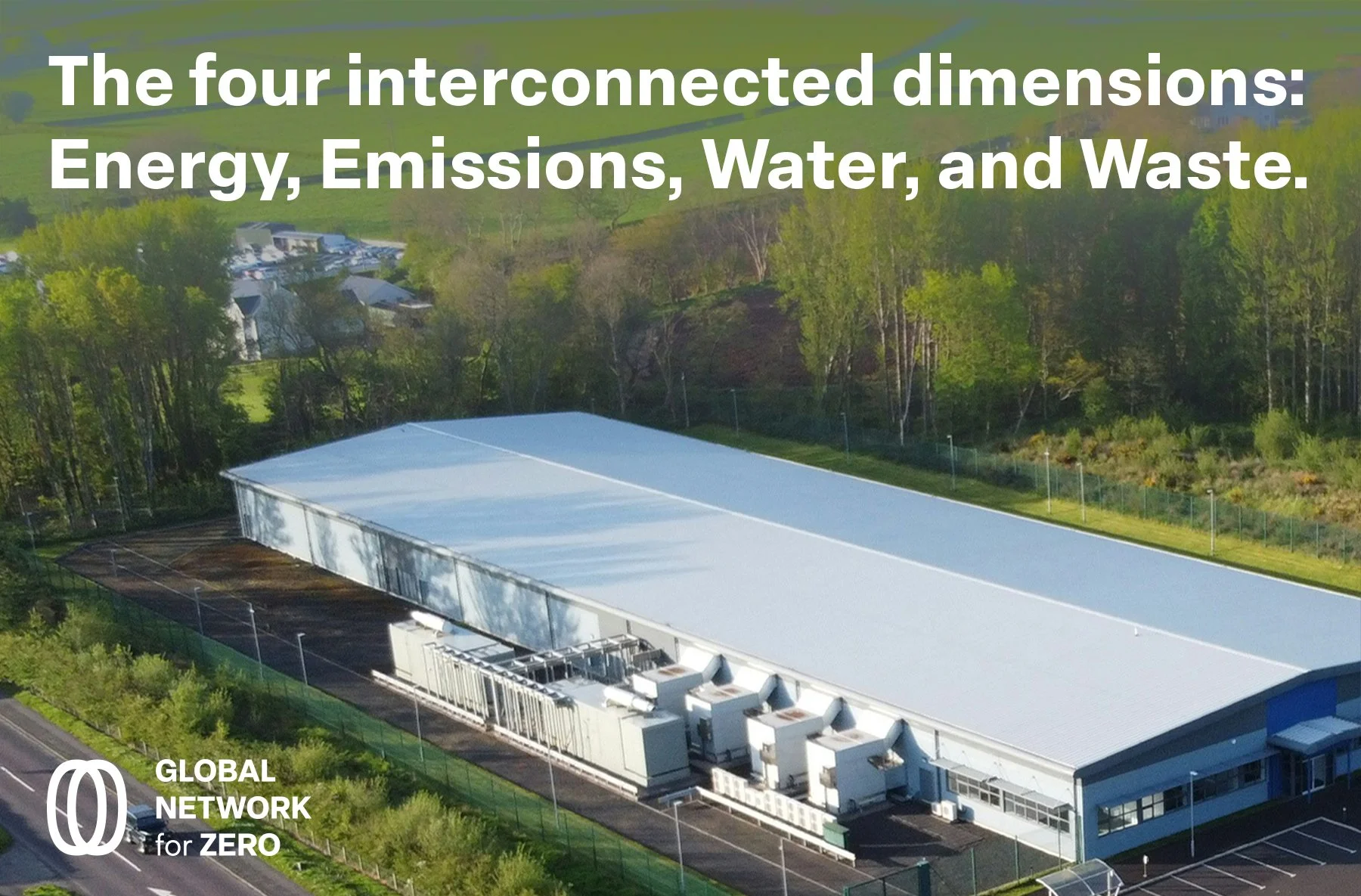
This marks a vital shift from simple energy efficiency to resource intelligence.
Organizations that master this balance will earn not only operational efficiencies, but also the trust, investment, and regulatory support needed to continue growing. This broader perspective reflects a larger shift occurring across the sustainability landscape.
From Commitments to Implementation
Data centers highlight a universal truth in sustainability: Ambition alone is not enough. To navigate Scope 1, Scope 2, and Scope 3 emissions while maintaining operational resilience, operators need frameworks that translate long-term goals into day-to-day action.
Net zero is not a single destination; it is a managed journey supported by measurable milestones, transparent reporting, third-party verification, and continuous improvement.
The organizations making the greatest progress are not necessarily those with the boldest commitments. They are the organizations with the clearest implementation strategies.
Increasingly, investors view sustainability performance as a proxy for risk management. As disclosure requirements expand, transparent performance measurement and third-party verification are becoming important tools for maintaining access to capital and supporting future growth.
At GNFZ, we believe the future of decarbonization depends on making progress practical. Organizations need more than aspirations. They need frameworks, tools, implementation support, and independent verification that help them move from where they are today to where they want to be tomorrow.
The future of AI and the future of net zero are increasingly connected. The expansion of digital infrastructure is inevitable – ensuring it strengthens our climate future rather than compromises it, is a challenge we must solve.