
If someone asked you whether a building you own, manage or work on is actually getting closer to net zero, what evidence would you put in front of them?
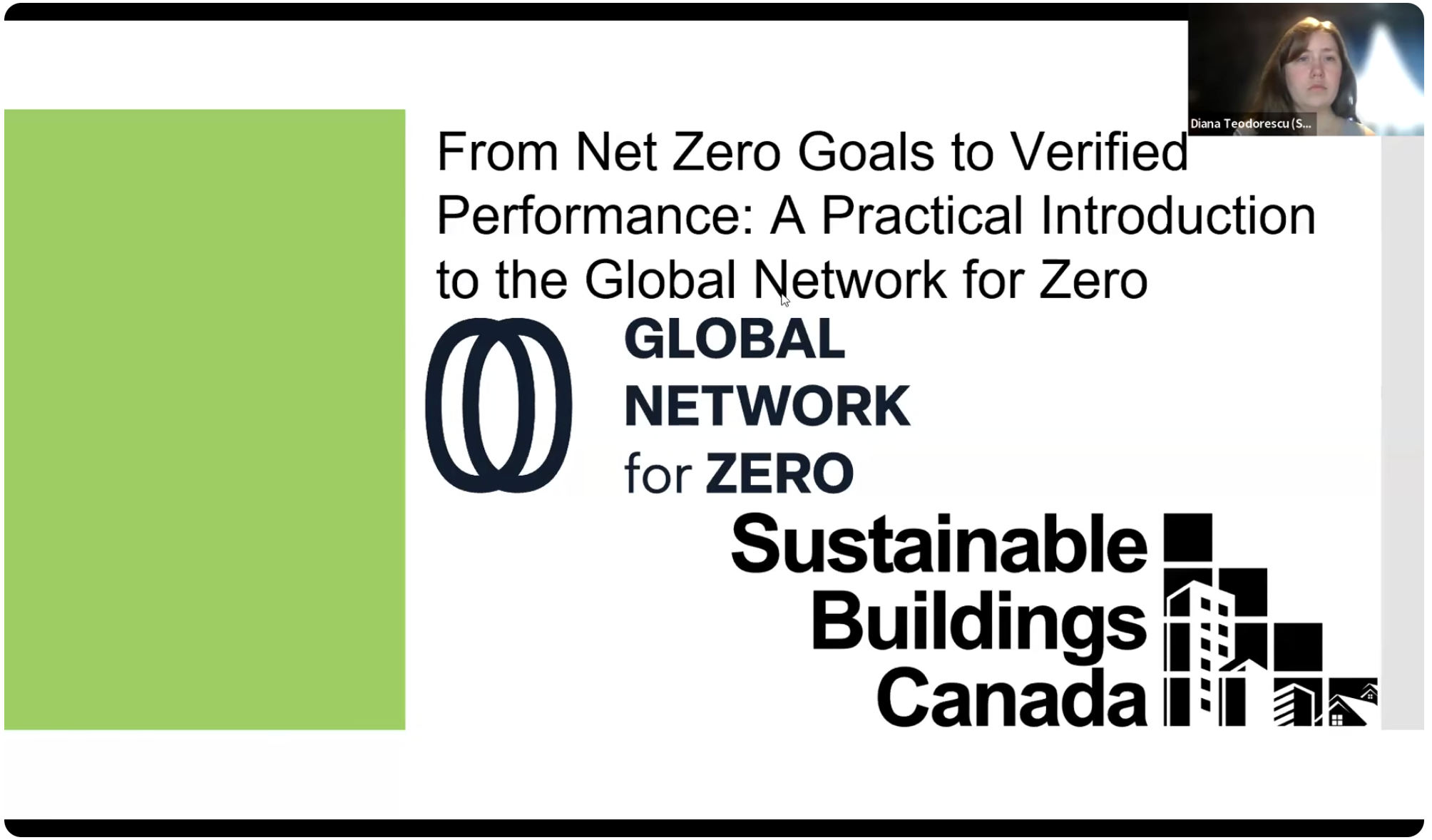
Watch the webinar: https://www.youtube.com/watch?v=jZJZQKCdFhs
That question is at the heart of why we founded the Global Network for Zero (GNFZ). And it is particularly relevant to the challenge facing Canada's built environment.
Buildings account for approximately 18% of Canada's national emissions when electricity-related emissions are included. The federal Canada Green Buildings Strategy identifies approximately 11 million existing buildings for accelerated retrofits. That is an enormous undertaking, requiring more than ambitious targets or new technologies. It requires a practical way to translate commitments into investment decisions and measurable improvements.
Connecting Building Performance to Business Decisions
For many Canadian building owners, decarbonization is ultimately an operational and investment challenge. Capital is limited, equipment has a useful life, operating costs matter and occupants must be considered.
Replacing a heating system, for example, is not simply an equipment decision. It is an opportunity to consider how that investment fits into a building's broader decarbonization pathway. Should envelope improvements or controls come first? What will deliver the greatest emissions reductions over time?
These decisions require a clear understanding of current performance and a plan grounded in the realities of each asset.
A Practical Pathway for Every Building
One of the biggest mistakes we can make is designing a net zero process that only works for buildings already performing well. We need to make rigorous decarbonization accessible to the buildings that need it most, not just those already close to the goal.
This is the principle behind GNFZ's incremental certification approach. As an independent net zero certification body, we help building owners, operators and organizations move from ambition to measurable, independently verified performance. Our approach is grounded in actual building data and the GHG Protocol, addressing Scope 1, 2 and 3 emissions, including embodied carbon where applicable.
Our pathway has four stages:
Assess: Establish an honest baseline using actual performance data, including energy consumption, emissions and other applicable environmental impacts.
Plan: Develop a credible decarbonization pathway with practical interventions, defined targets and measurable milestones that reflect the building's conditions and available resources.
Progress: Implement improvements and independently verify milestones, allowing owners to demonstrate meaningful progress along the way.
Final Certification: Verify that the building has achieved the applicable net zero requirements.
The distinction matters: Validating a plan is not the same as demonstrating progress, and neither is the same as achieving net zero.
We also believe investment should prioritize improvements within the building itself. While credible carbon offset certificates can play a role, our preference is to direct resources toward efficiency improvements and emissions reductions within the asset wherever possible.
Importantly, GNFZ does not require buildings to abandon existing certifications, benchmarking tools or technical approaches. We are rating-system agnostic. Our role is to connect those efforts to a consistent, independently verified pathway toward net zero.
Scaling Progress Across Portfolios
For organizations managing dozens or hundreds of buildings, the challenge extends beyond individual properties. A portfolio-wide net zero target provides direction, but it does not tell an owner where emissions are concentrated, which buildings should be prioritized or where the next investment will make the greatest difference.
GNFZ's net zero portfolio certification connects individual building performance with broader organizational objectives. Owners can identify high-emitting assets, coordinate improvements across similar buildings, evaluate results and make more informed decisions about future investments.
This is particularly valuable in Canada, where organizations may operate properties across multiple provinces with significantly different energy systems, climates and operating requirements.
A credible framework should provide consistency in how performance is measured and verified without assuming every building should follow an identical sequence of improvements. That is how decarbonization becomes economically practical as well as environmentally meaningful.
Making Canada's Progress Measurable
Canada's building sector has the expertise and ambition to make meaningful progress, but still needs a stronger connection between those efforts and verified performance. I recently had the opportunity to explore this idea during a webinar with Sustainable Buildings Canada, From Net Zero Ambition to Verified Performance. We discussed how building owners can establish credible baselines, develop practical decarbonization plans and demonstrate progress across individual buildings and portfolios.
Watch the webinar: From Net Zero Ambition to Verified Performance – Sustainable Buildings Canada
At Global Network for Zero, we believe net zero should not remain a distant promise. It should be a measurable process that starts wherever a building stands today and continues until results are achieved and verified.
So I would leave Canada's real estate community with one question: Which building in your portfolio could be measurably closer to net zero a year from now if you had a clear baseline, a practical plan and a way to verify the results?
That is where we should begin.