
Scope 2 Emissions: Why Location and Market-Based Accounting Both Matter
When organizations talk about reducing building emissions, electricity is often at the center of the conversation. But measuring those emissions is not always as straightforward as looking at a utility bill.
For organizations managing buildings, portfolios, or leased spaces, one of the most important distinctions to understand is the difference between location-based and market-based Scope 2 emissions accounting. The distinction matters because the two methods answer different questions. One reflects the physical electricity grid serving a building, while the other reflects the contractual choices an organization makes about where its electricity comes from.
For building owners and landlords, there is yet another layer of complexity: Who is actually responsible for the electricity used by tenants? Getting these boundaries right is essential for credible net zero reporting — and increasingly important as organizations move from aspirational climate commitments toward measurable, verified performance.
Two ways of looking at the same electricity use
Scope 2 emissions are associated with purchased electricity, steam, heating, and cooling. For electricity, the GHG Protocol Scope 2 Guidance calls for organizations to report emissions using both a location-based and a market-based method where applicable. The two approaches are complementary rather than competing.
Location-based accounting: What does the grid serving the building look like?
The location-based method uses the average emissions factor for the electricity grid in the region where the building is located. In other words, it asks: How carbon-intensive is the electricity grid physically supplying this building?
This calculation is independent of whether an organization has purchased renewable energy contracts, RECs, or other contractual instruments. It provides an important picture of the building's relationship with the physical electricity system and can therefore be particularly useful for understanding the underlying emissions intensity of the energy being consumed.
Market-based accounting: What has the organization contracted for?
The market-based method takes contractual energy procurement into account. This can include instruments such as:
Power purchase agreements (PPAs)
Renewable Energy Certificates (RECs)
Green tariffs
Other qualifying contractual instruments
For electricity that is not covered by these instruments, a residual-mix emission factor may apply.

The market-based method therefore asks a different question: What electricity procurement choices has the organization made, and what emissions factor is associated with those contractual choices?
These two perspectives should not be treated as interchangeable. Under GNFZ’s certification, location-based and market-based results are disclosed independently rather than netted against one another. That distinction becomes particularly important when organizations are trying to demonstrate progress toward net zero.
A building-level example
Consider a building with annual electricity consumption of 10.8 million kWh. The building has:
10 million kWh of grid electricity imported through its high-tension meter
800,000 kWh of on-site renewable energy that is self-consumed
2 million kWh covered by an off-site solar PPA
3 million kWh covered by RECs
5 million kWh of remaining unbundled grid electricity
For this example, assume the grid emission factor is 0.716 kgCO₂e/kWh, while the applicable residual-mix factor is 0.850 kgCO₂e/kWh. Here’s what each calculation shows:
Location-based Calculation:
This looks at the electricity physically drawn from the grid.
10,000,000 kWh × 0.716 kgCO₂e/kWh = 7,160 tCO₂e so, therefore, the building has 7,160 tCO₂e of location-based Scope 2 emissions.
This number does not change simply because the organization has entered into a PPA or purchased RECs. Those instruments do not change the physical electricity flowing through the grid to the building.
Market-based calculation:
This considers the building's contractual procurement.
In this example, the PPA and REC volumes carry a zero emission factor, leaving 5 million kWh of unbundledelectricity to be calculated using the residual-mix factor: 5,000,000 kWh × 0.850 kgCO₂e/kWh = 4,250 tCO₂e. The building's market-based Scope 2 emissions are therefore 4,250 tCO₂e.
The difference between the two results is significant: 7,160 − 4,250 = 2,910 tCO₂e. But that 2,910 tCO₂e difference should not be interpreted as meaning that the building physically used less grid electricity. Instead, it reflects the emissions impact associated with the organization's contractual electricity procurement.
That is precisely why both numbers are valuable. Location-based accounting shows the physical grid reality. Market-based accounting shows the effect of procurement decisions.
The landlord and tenant question
The accounting becomes more complicated when a building contains multiple tenants. Who reports the electricity used by tenants? Under an operational-control consolidation approach, which is commonly relevant for multi-tenant assets, tenant-metered electricity falls outside the landlord's Scope 1 and Scope 2 inventory.
Instead, it is reported by the landlord as Scope 3, Category 13: Downstream Leased Assets. The landlord's own Scope 2 inventory includes the electricity associated with its operational control — for example, common areas and base-building operations. Meanwhile, the tenants report their own electricity consumption as Scope 2 within their respective organizational inventories.
At first, that can appear to create double counting, but it does not. The same electricity can appropriately appear as Scope 3 Category 13 for the landlord and Scope 2 for the tenant, because the two organizations are looking at the emissions from their respective organizational boundaries. This mirrored treatment is permitted and provides consistency across the lease boundary.
What this looks like in practice
Using the same example, suppose:
10% of the building's electricity use is associated with landlord-controlled common areas
90% is associated with tenant-occupied space
The landlord's common-area electricity consumption would be: 1.08 million kWh. Using the location-based factor: 1,080,000 kWh × 0.716 = approximately 773 tCO₂e. If that common-area electricity is fully covered by an earmarked PPA or REC procurement, the market-based result could be 0 tCO₂e under the assumptions in this example. The remaining 9.72 million kWh associated with tenant-occupied space is reported by the landlord as Scope 3 Category 13.
For example:
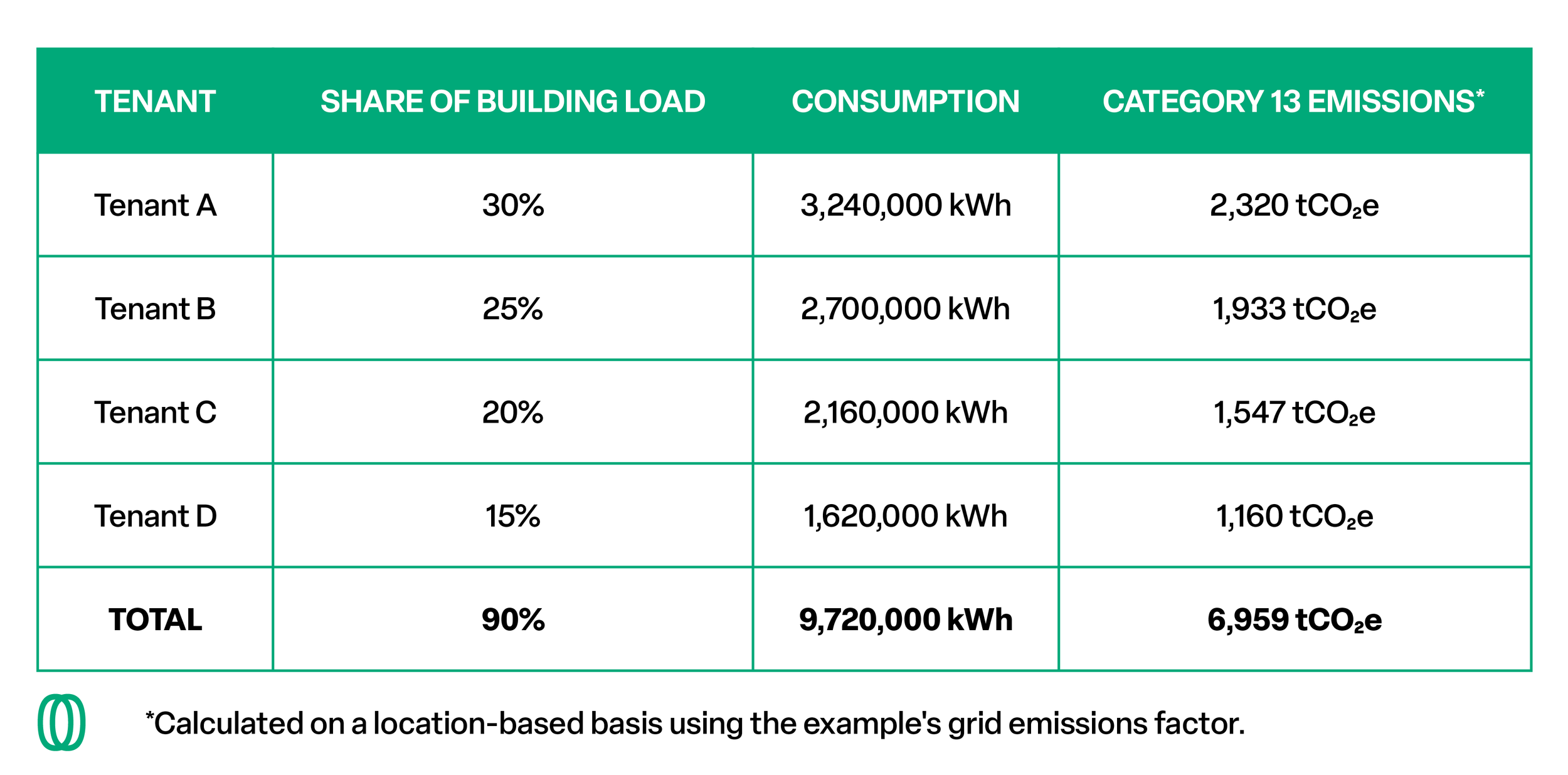
Importantly, the landlord's PPAs or RECs are not automatically extended to the tenant electricity represented in Category 13.
If a tenant has its own qualifying renewable energy procurement, that tenant can account for those instruments within its own market-based Scope 2 inventory. This means that the landlord and tenant may have different market-based results for the same physical building, because their contractual procurement decisions are separate.
Why allocation matters
One of the most important practical considerations is determining who gets credit for renewable energy procurement. If a building owner purchases renewable energy and the building has multiple occupants, the allocation of that procurement needs to be clearly established.
For example, is the renewable energy:
Allocated proportionally across occupants?
Earmarked specifically for common-area electricity?
Assigned according to another documented contractual arrangement?
The answer can materially change the emissions reported by the landlord and tenants. For this reason, GNFZ recommends that the allocation convention for renewable energy, PPAs, and RECs be defined and disclosed before certification. This is more than an accounting detail. It is fundamental to creating a transparent and auditable net zero claim.
What this means for organizations pursuing net zero
For organizations managing individual buildings, portfolios, or leased assets, Scope 2 accounting should not be reduced to a single emissions number.
A credible approach should make three things clear:
What is happening physically? Location-based accounting provides visibility into the emissions intensity of the electricity grid serving the asset.
What has the organization chosen contractually? Market-based accounting captures the impact of qualifying electricity procurement decisions.
Who is responsible for the emissions? Clear organizational and operational boundaries determine whether electricity belongs in an organization's Scope 2 inventory or, for landlords, Scope 3 Category 13.
These distinctions become increasingly important as organizations move toward more sophisticated climate reporting and verification.
A clearer path to credible net zero reporting
At GNFZ, we believe emissions accounting should provide more transparency, not less. That means reporting location-based and market-based emissions independently, maintaining clear organizational boundaries, and documenting how renewable energy instruments are allocated.
For multi-tenant buildings, that means recognizing tenant electricity as Scope 3 Category 13 for the landlord when operational control applies, while maintaining the corresponding Scope 2 reporting within each tenant's own inventory. It also means resisting the temptation to use renewable energy procurement to obscure the underlying physical emissions profile of a building.
The result is a more complete picture: One that shows both the carbon intensity of the energy system a building relies on and the actions an organization is taking to change its emissions profile.
This dual, boundary-explicit approach can help organizations build more credible inventories today while creating a stronger foundation for broader sustainability and climate disclosures as they move from individual assets to portfolios and enterprise-wide net zero strategies. GNFZ's methodology is designed to provide that foundation across building, landlord, tenant, portfolio, and organizational boundaries.
The takeaway
Location-based and market-based Scope 2 accounting are not competing answers. They are two pieces of the same story. One tells us about the electricity system a building physically relies on. The other tells us about the procurement choices an organization has made.
When those perspectives are reported separately — and when landlord and tenant boundaries are clearly defined — organizations can provide a more transparent, credible picture of their progress toward net zero. And that is ultimately what good emissions accounting should do: Turn complex data into information that can support better decisions, stronger accountability, and measurable progress.
